Nā Keʻehi I Ka Haʻa - Hula Steps
Contributed and Researched by Kalani N. Poʻomaiahealani
The following list is meant to encourage those interested in the cultural dance of Hawaiʻi. You're invited to learn what has been forgotten with the passage of time. The first 26 dance steps (nā keʻehi i ka haʻa) are recorded in the Hawaiian Dictionary authored by Mary Kawena Pukui and Samuel H. Elbert. Most of them are used today but others are probably unheard of by many modern day students and still others have been taught with different names. Some of the steps are called by more than one name and will be listed together. There are steps, nā keʻehi, that are not listed in the dictionary as hula steps, but have names that describe the action of the step and still there are others, with names whose origin is obscure. Each of the 3 groups will be listed separately. The term haʻa is used instead of hula. Haʻa as defined in the dictionary : a dance with bent knees; dancing; called hula after mid 1800's. To simplify matters, the following explanations will be given, beginning with a rightward movement.
Hula Step Names Found In The Dictionary
- ʻAi: dancing style or type
- ʻAi ʻami: type of haʻa with little foot movement, hips revolve throughout the dance
- ʻAi haʻa: hula step executed with bended knee
- ʻAi kāwele, Kāwele: haʻa step; one foot makes a half circle forward and to the side without touching the floor; usually in combination with other steps as the holo or ʻuwehe; used in "A Koʻolau Au"
- ʻAmi: rotation of hips
- ʻAmiʻami, ʻAmi hula: jerking motion of the hips back and forth in a crude or vulgar manner
- ʻAmi kāhela, ʻAmi poepoe: hip rotates with the weight on the right hip as the left heel lifts very slightly, then reversing this action
- ʻAmi kūkū: like the ʻami kāhela except the revolutions are smaller, faster and in groups of three; sometimes combined with two slower kāhele revolutions
- ʻAmi kuʻupau (uninhibited), ʻAmi honua, ʻAmi hue: rapid revolution of the hips in the haʻa; an uninhibited ʻami, like in a Tahitian dance
- ʻAmi ʻôniu (spinning): figure-eight haʻa step; the revolving hips (ʻami) form an "8" with the weight shifting
- ʻAmi ʻōpū (stomach): ʻami haʻa step with the abdomen thrust forward, considered in poor taste
- ʻAui: haʻa step where the dancer turns to the side and points the foot out once or several times, drawing the foot well back between each pointing; at the same time the body is tipped with the lowered hand pointing to the outpointing toes and the other hand raised in the opposite direction. In the hula "Kaulilua", this step is immediately executed upon the kahea "pa"
- Hela: one foot is placed at about a 45 degree angle to the front/side with the weight on the opposite hip and the knees bent; the foot is then returned to the original position and the step is repeated with the other foot.
- Holo: running holo step to the side, similar to kaholo except the feet are not necessarily brought together. Used in "Aua Ia I Kamapuaʻa"
- Hue: revolving of the hips in time with the drummer, who beats as fast as possible, to see which dancer can dance the longest. Similar to ʻai ʻami and done at the end of the program
- Kaʻapuni: haʻa step now called around the island; the dancer pivots on the ball of one foot in a complete circle; the other foot takes four or more steps to complete the circuit
- Kāhele: Regular ʻami rotations. See ʻAmi kuku, Keʻehi #8
-
Kāholo: the haʻa vamp step, more common in modern than in ancient dances, consisting of 4 counts:
- #1 one foot is extended in a straight line to the side
- #2 the other foot is brought along side
- #3 first foot is again extended in a straight line to the side
- #4 the other foot is again brought along side the first foot
- Kāwelu, Kalākaua: One foot taps time with the heel, the toes being stationary while the other foot, flat position, steps forward and back, the same distance, 2 or more times. The step is repeated, reversing the feet. This step is called Kalakaua in English because it was used to begin the haʻa hula dedicated to King David Kalākaua. Some halaus use the term kalākaua when this step is done in place to differentiate from kāwelu as the same step (front and back) that moves progressively to either side
- Kelamoku: hula step invented by Hawaiian sailors. One foot swings alternately on ball and heel of same foot while the other points the toes front and back four times, then reversed; knees are bent, arms out, bent at the elbows, with the hands held up and fingers often snapping while swaying the body
- Kîʻi, Wāewae Kîʻi: right foot points to the side (3:00), front (1:00), back into position with the left foot. Left foot repeats the same movements, side (9:00), front (11:00), back into position, on the opposite side. Some halaus incorporate an ʻuwehe when the 2 feet are back in the same position. This step is often used at the end of Olapa/Alaʻapapa dances. Legend says Hiʻiaka-i-ka-poli-o-Pele and Hopoe danced the hula on Puʻu Kiʻi, an islet at Ka-pueo-kahi harbor of Hana, Maui. It is said that this step was first danced here.
- Lele: the dancer walks forward lifting the heel with each step, with a slight inward movement
- Lele ʻUwehe: the ʻuwehe and lele steps are combined. Step with right foot, bringing the left foot to a hela position, bring left foot back into position beside right foot, then ʻuwehe. Repeat on other side
- ʻO: The hip is thrust outward in a circular "O" movement; similar to the kawelu except the foot pivots while turning to the opposite direction
- Ue, Uwe: haʻa step where the kahea: "e" imperative and "ue" is announced to the drummer and the beat is changed. The dancer extends the right foot forward with toes pointed, while both arms are brought forward to chest level with hands crossed and fingers tipped upward; the left hand stays up, while the right arm and foot swing back in an outward arc, ending with right foot pointing back. The right arm and foot are moved forward and the step is repeated to the left. Then three short steps are taken forward turning the body to the right. In the last movement, the left hand is forward and the right foot and arm are back. This step is often used to end pahu hula, i.e."Kaulilua"
- ʻUlili: similar to ʻuwehe except only one heel at a time is raised.
- ʻUwehe, ʻuehe, ʻuweke: one foot is lifted with weight shifting to the opposite hip as that foot is "Uehe" lowered; both knees are then pushed forward by the quick raising of the heels, with continued swaying of the hips from side to side. The actions are then repeated in reverse.
Step Names Not Found In the Dictionary
The names of the following steps were probably derived from their actions. Each step is described and defined
- 'Ai holoholo: same as #14 holo
-
Akalewa: sway the hips from one side to the other
Definition: to sway the hips daintily and gracefully -
Haʻanapu: sway the hips from side to side
Definition: to sway as in a dance -
Hehi: on the count
Definition: to stamp, tread, trample, step on, trampling- #1 stamp the right foot while raising the left knee to slightly below the hip
- #2 stamp the heel of the same foot leaving the left knee raised
- #3 stamp the left foot while raising the right knee to slightly below the hip
- #4 stamp the heel of the same foot leaving the right knee raised
-
Kuʻi: hop onto the right foot moving to the right while bringing the left heel with the toes pointing to the extreme left, approximately 6" in front of the right knee being sure that the body doesn't bounce (isolate action to the legs). The hop is executed 4 times then repeated to the left. Note: a loud stomping sound is preferred when executing the hops
Definition: 1. To pound, punch, strike; to beat out; to churn, 2.To join, stitch, sew, splice, united; joined; seam Hula kuʻi, any interpretive hula so called since the days of Kalakaua; literally, joined -
Kuʻi Molokaʻi: similar to the kʻui except while hopping to the right as in the kuʻi, the left leg is thrust outward to the left, fully extended. After the 4th count to the right, repeat the movements to the left. Emphasize the stomping sound
Definition Molokaʻi: this dance (see hula kuʻi Molokaʻi) originated on the island of Molokaʻi -
Hilo Kuʻi: start by lightly touching the ground with the right foot in an alternating heel-toe movement. Starting with the heel and ending with the heel in 7 counts, with the foot returning to the starting posiion on the 8th count. When placing the heel, the toes need to be pointing to the right at a 45' angle. When placing the toes, the foot should be perpendicular to the ground with the heels now taking the extreme right position. All the while, the opposite foot bearing the entire body weight shuffles across the floor to the right, alternating heel and toes, also in an 8 count. However, on the 1st count, the left foot remains stationary and begins the shuffle on the 2nd count with the heel moving to the right first. The shuffle is accomplished by placing all the weight of the body onto the ball of the left foot as the heel is moved to the right, then transferring the weight to the heel as the ball of the left foot is then moved the right. This movement is repeated until the right foot is returned to the starting positon on the 8th count. The entire process is now repeated in the opposite direction
Definition Hilo: to twist, braid, spin; twisted, braided - Kaholo Huli Hapahā: Quarter turn or holo/vamp step in a semi-circle. The name was coined by Kalani Poʻomaiahelani
- Kiʻi Kuhi: To make time; keeping haʻa gestures with left hand gestures front and back; right hand taps ʻuliʻuli on lap
Step Names with Unknown Origin
- Hoʻoholo, Glide, Slide: kaholo hula step in excess of 2 counts; usually 3 or 4 counts
-
Kao: this step name is widely used but there is no origin for its usage or meaning for the word
Usage: sway side to side -
Uleipahu: on the count of:
- #1 strike the ball of the right foot firmly on the floor
- #2 strike the heel of the same foot
- #3 strike the ball of the left foot firmly on the floor
- #4 strike the heel of the same foot
Arm Positions
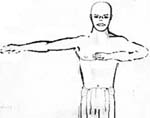 Position #1 Kaholo-Vamp |
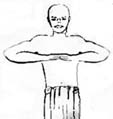 Position #2 Kāwelu, Kalākaua |
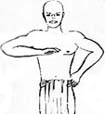 Position #3 ʻAmi |
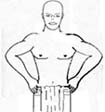 Positon #4 ʻUwehe, ʻUweke |